
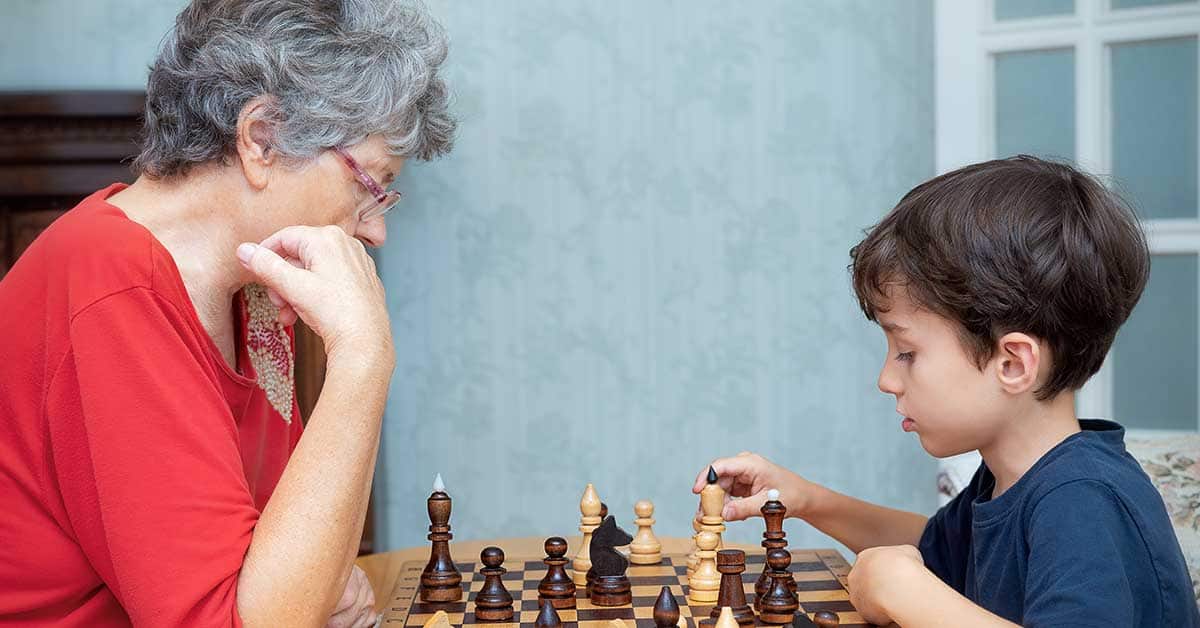
She knew enough about chess to know that her grandson was making up the rules. She hadn’t played in years, so when he pulled out the board and asked if she wanted to play, she warned him that she might be a little rusty. He assured her that was fine because he knew exactly how to play.
Pawns were moving in directions she didn’t remember being allowed. A bishop had somehow changed its mind halfway across the board. And his Queen seemed to have extraordinary powers that she was fairly certain had never been recognized by the official rules of chess.
She watched him move another piece. “Can you do that?” “Yes.” “Are you sure?” “Pretty sure.”
She smiled. Apparently, they were playing his version of chess.
She could have corrected him. She could have pulled up the rules on her phone or found the little instruction booklet that came with the set. Instead, she moved one of her pieces and waited to see what he would do next.
He was completely absorbed.
Every move came with an explanation, although some explanations seemed to be created after the move rather than before it. He talked through possibilities, changed his mind, moved pieces back, and occasionally invented a rule that was suspiciously helpful to whatever situation he found himself in.
Every now and then, she showed him something she remembered. She explained how the pieces could protect one another and how they worked together to protect the King.
“Why the King?” he asked. “Why not the Queen?”
“Well, the Queen protects the King too. That’s a very important job.” He considered that for a moment, apparently satisfied, and went back to moving his Queen where he pleased. They played for a long time. She wasn’t sure they were actually playing chess, but they were having a wonderful time.
Then someone walked into the room, watched for a few minutes and realized what was happening.
“You know that’s not how you play chess.” Her grandson looked up. The real rules were explained.
Where the pieces could move. What they could and couldn’t do. Why certain moves mattered. How you had to think ahead. Chess, it turned out, wasn’t just about moving pieces around a board. There was strategy involved…A lot of strategy.
So they started over and tried playing the right way.
At first, her grandson paid attention. She did too. They slowed down. They thought about their moves. She reminded him what each piece could do.
A few minutes earlier he had been leaning over the board, talking constantly, inventing possibilities and laughing whenever one of his questionable moves worked. Now he was sitting back in his chair. Waiting. Thinking. Losing interest. She could see it happening.
It wasn’t dramatic. He didn’t complain or announce that he didn’t want to play anymore. The light simply started going out of the game.
She looked at him across the chessboard.
There was nothing wrong with the rules. In fact, he needed to learn some of them if he was ever going to understand the game. So she showed him check. Then she explained checkmate. They moved a few pieces around together until he understood how one player could put the other’s King in danger and how the other pieces could help protect it.
That interested him…for a while.
Eventually they reached check, then worked their way out of it, then back toward it again. She could see his patience beginning to disappear.
“How about this,” she said. “Let’s make three more moves and then call it a draw.”
His face changed immediately. “Okay.”
They made the first move. Then the second. He was watching carefully now. She made the third.
“DRAW!”
He yelled it as though he had just won the World Chess Championship. She started laughing. He was already out of his chair.
“Pool?” “Pool.” And just like that, the chess game was over.
No analysis of what either of them should have done differently. They left the pieces exactly where they were and went swimming.
Later that afternoon, she walked back through the room and saw the chessboard still sitting on the table. She stopped.
The King was in check. One bishop was stranded near the edge of the board. Several pawns had disappeared. And the Queen was sitting somewhere she suspected the Queen had absolutely no legal right to be. She reached for the pieces to put them away, then stood there for a moment looking at the unfinished game.
When had playing become something we had to be good at? She couldn’t remember when it had happened to her.
As a child, she had played simply because there was something to play. A ball, a bicycle, a deck of cards, a patch of grass, another child nearby. Nobody needed to explain why it was worth doing.
Then somewhere along the way, life became more organized.
There were rules to learn and responsibilities to manage. Things had to be done correctly. Time mattered. Results mattered. Being prepared mattered. And she became very good at all of it.
Even the things she did for fun eventually seemed to acquire a purpose. Exercise was good for her health. Reading kept her mind active. Travel broadened her perspective. Hobbies were things she could improve at.
Maybe that was why she noticed the change in her grandson so quickly. Nothing had been wrong with teaching him the rules. He had learned something. He now knew about check and checkmate, and someday he might want to learn the strategy that made chess such an extraordinary game.
But today, he wanted to play. And for a little while, getting it right had become more important than having fun. She wondered how often that had happened to her without her noticing.
How many things had she stopped doing because she wasn’t particularly good at them? How many things had become less enjoyable once she started measuring whether she was improving? How many perfectly good afternoons had she filled with things that needed to be accomplished because doing nothing useful somehow felt irresponsible?
She looked again at the chessboard. They had learned enough of the rules to play. And ignored enough of them to enjoy it. Maybe there was something to that.
From outside she heard him calling her. “Are you coming?”
She looked toward the door. “In a minute.”
She started to straighten the chess pieces, then changed her mind. The board could wait.
The real rules were written down and tucked somewhere safe. They could get them out another day when they wanted to play strategy.
Today, they had played chess. Three more moves. A draw. And then the pool.
She looked at the ridiculous unfinished board one more time. And smiled.
Then she went outside.